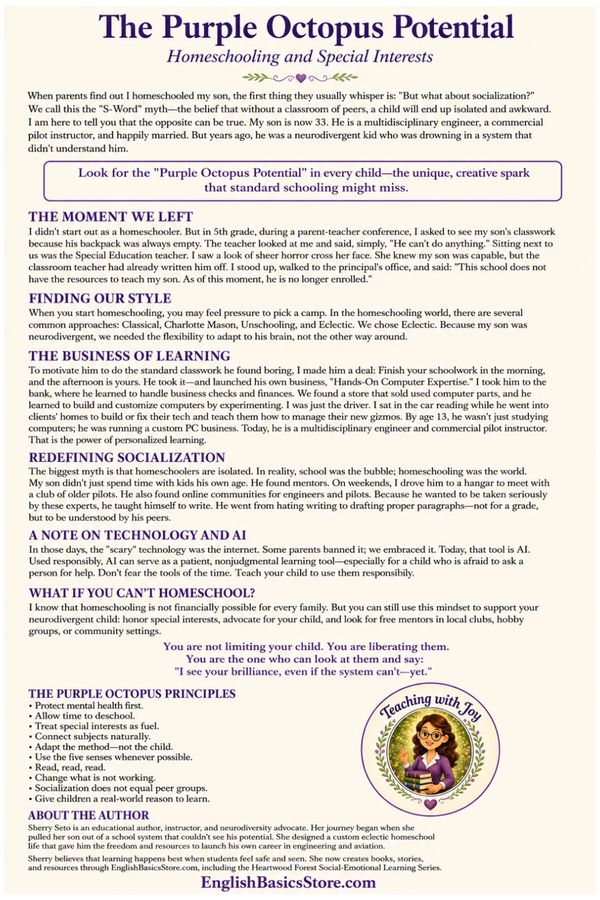
Embrace the "Purple Octopus Potential" to Heal and Homeschool Your Neurodivergent Child!
Traditional classrooms view intense, specialized interests or passions as distractions.
Homeschooling views them as superpowers.
Written for parents of kids who don't fit into a rigid, one-size-fits-all box this Homeschooling page dismantles the myth of school-at-home and encourages you to take the plunge.
By focusing on healing the nervous system first and mapping core subjects to your child's natural passions, you can replace daily battles with genuine curiosity, creativity, and the joy of accomplishment.
Just what is the Purple Octopus Potential? Scroll down and see if our eclectic nontraditional approach to homeschooling resonates with you and your child!
Understanding the "Purple Octopus Potential"
Years ago, my son designed a business card with a purple octopus to represent his "hands-on" tech service. To me, it became a manifesto.
An octopus has eight arms, all moving at once, reaching for different things.
In a classroom, those "arms" (intense interests or "obsessions") are often seen as distractions.
In homeschooling, those arms are the engines of education.
We don't prune the arms; we give them something to hold onto.
The Final Teacher-Parent Conference
If you are a parent sitting in a plastic chair at a school conference, hearing that your child "can't do the work," I have been where you are.
When my son was in school, a teacher looked at me and said, simply: "He can't do anything."
That day, I walked to the principal’s office and withdrew him. I realized then that when a school says, "he can't," they actually mean, "our system doesn't have the resources to reach him."
That moment launched a journey of discovery. We didn’t just "do school at home"; we redefined what learning looks like. We found that when you stop fighting the child and start fighting for their interests, the "battle" of homeschooling disappears, replaced by a life of creativity and accomplishment.
And, yes, even joy!
The Mind Cannot Learn If the Nervous System is on High Alert.
Pillar 1: Emotional & Physical Regulation (The Foundation)
· Prioritize Healing: If a child has been bullied or shamed, or lacks self-confidence due to perceived failures, focus on "Deschooling."
· Establish Comfort Zones: Let them work where they feel safe—on a beanbag, the floor, or in a sunny window.
· Build Confidence: Celebrate "Small Wins." Sincere praise for effort builds the stamina and self-confidence needed for harder subjects.
Pillar 2: The 50/50 Passion Split (The Method)
I recommend a 50/50 model: Spend half your day on "Core" (Math/Literacy) and the other half on Passion Projects.
· Student-Driven Exploration: Let their interests lead. If they love technology or nature, use those as the "hook."
· Multi-Sensory Engagement: Move beyond the book. Use building kits for math, cooking for chemistry, and nature walks for biology.
Pillar 3: Structure & Technology (The System)
Flexibility requires a framework to keep the environment productive.
· Organized Routines: Maintain a daily flow to reduce anxiety and create a sense of rhythm.
· Embrace Technology Wisely: Don't fear tools like Artificial Intelligence (AI). AI is a non-judgmental, patient tutor—a "Safe Harbor" for learners.
· Life Skills: Incorporate real-world tasks like banking or grocery budgeting.
Grades K - 5 The Wonder Years
For parents of younger children (K-5), the goal isn't "rigor"—it’s wonder.
At this age, children learn best when their hands are busy and their curiosity is sparked.
If your child is a "girly girl" who also loves to build, or a boy "dino-expert" who loves to paint, lean into that!
The Golden Rule: Curiosity is the Curriculum.
Gentle "Octopus" Ideas for Little Learners:
· The Royal Architect: Use building blocks or kits to design a castle or dollhouse. Measure the walls (Math) and tell stories about who lives there (Storytelling/Language Arts).
· Garden Science: Plant a windowsill herb box. Drawing the sprouts as they grow is both Art and Biology.
· Tea Party Math: Practice addition with cookies and guests. "If we have 6 treats for 3 friends, how many does each person get?"
· Fashion History: Look at pictures of how people dressed 100 years ago. It’s a soft, visual way to introduce History.
My son loved computers and airplanes--our entire curriculum revolved around everything related to them and eventually generalized to other more traditional subjects.
Morning: Slow Start & Reading
Read together, listen to an audiobook, or talk about a favorite topic.
Why it helps: Eases your child into the day and builds vocabulary, attention, and trust.
Mid-Morning: Playful Math Practice
Use blocks, snacks, beads, puzzles, measuring cups, money, or math games.
Why it helps: Makes math hands-on instead of stressful or abstract.
Noon: Learning Through Lunch
Let your child help prepare food and talk through the steps.
Why it helps: Builds real-world math, sequencing, vocabulary, and independence.
Afternoon: Passion Project Time
Build, draw, explore outside, research animals, code, craft, read, or create.
Why it helps: Connects learning to your child’s natural curiosity.
End of Day: Gentle Reflection
Ask, “What did you enjoy learning or doing today?”
Why it helps: Builds confidence and helps you plan tomorrow around your child’s interests.
A child’s interest can become the doorway into reading, writing, math, science, geography, history, art, and life skills.
Suggestions and Random Ideas
Design a Game
A child who loves games can design a game, create characters, write rules, calculate points, map out a challenge, or explain how the game works.
Learning inside the interest: math, logic, planning, writing, storytelling, sequencing, problem-solving.
Animals or Pets
A child who loves animals can research habitats, food, climates, animal care, life cycles, maps, and behavior.
They can create a pet-care chart, animal notebook, poster, slideshow, or mini-book.
Learning Inside the Interest: science, geography, reading, writing, art.
Cooking or Baking
A child who loves helping in the kitchen can read recipes, measure ingredients, double or halve a recipe, follow steps, compare textures, and observe changes as food heats, melts, freezes, or rises.
Learning Inside the Interest: fractions, sequencing, chemistry, reading, problem-solving, life skills.
Nature or Bugs
A child who loves being outside can keep a field journal, draw what they see, label parts of a plant or insect, describe colors and movement, compare leaves, or research a discovery.
Learning Inside the Interest: science, writing, art, observation, vocabulary, classification, charting, graphing.
Planes
Join a pilot's club (my son's met in a hanger--the pilots loved his enthusiasm, and he became an honorary member.)
Computers
My son taught himself how to build computers from spare parts (we found a store that sold them), and figured out how to code, among other techy things. (Plus, yes, we created a successful computer business, well, he did! I just drove and waited while he happily built his customers' computers from scratch and taught them how to use the technology (at 11 years old--it was the only way I could motivate him to do his schoolwork in the morning!).
Get Creative with Your Time and Resources
We had the time, flexibility, and some resources. Do what you can; you and your child can put your heads together and get creative with your time and resources, too! And remember, used wisely, the internet is an amazing tool and ideal for neurodivergent minds!
Day 1: The “Yes” Day
Say yes to safe, creative interests. Watch what your child reaches for when pressure is removed.
Day 2: The Observation Walk
Take a walk with no lesson plan. Let your child lead and notice what catches their attention and what he or she talks about.
Day 3: The “Dream School” Talk
Ask, “If we could learn about anything today, what would it be?” Listen for the first arm of the Purple Octopus.
Redefining Socialization
The biggest myth is that homeschoolers are isolated. In reality, school was the bubble; homeschooling was the world. My son didn't just hang out with kids his own age (who sometimes bullied him). He found encouraging mentors and friends that respected him in the real world.
The Pilot Club: On weekends, I drove him to a hangar to meet with a club of older pilots. They treated him like an equal, engaging hm in discussions and listening thoughtfully to his ideas.
The Online Community: He found online forums for engineers and pilots. He found a mentor there whose writing style he admired. Because he wanted to be taken seriously by these experts, he taught himself to write.
He went from hating to write to drafting proper paragraphs in 5th grade—not for a grade, but to be understood by his "peers", as he saw them. He became proficient at typing.
Using AI Wisely
In son's day, the "scary" technology was the internet. Some parents banned it; we embraced it. Today, that tool is Artificial Intelligence (AI).
While schools often ban AI out of fear of cheating, home educators have the freedom to use it properly.
For a neurodivergent learner, or a child with trauma from school, asking a human teacher for help can be terrifying.
AI is the ultimate non-judgmental tutor. It never rolls its eyes. It never sighs. It never gets frustrated if you ask the same question ten times. It is a "Safe Harbor" for learning. (Confession: I am also neurodivergent, with my own school traumas. AI is a gamechanger for me, too!)
Don't fear the tools of the time. Teach your child to use them responsibly. That is how they become the innovators of tomorrow.
I know that my family was privileged. We could survive on one income, which gave me the time to drive my son to airports and sit in parking lots. I know that for many, this isn't financially possible.
But you can still use this mindset to support your neurodivergent child:
Honor Their "Special Interests": Don't call them obsessions. Let their home life be their sanctuary where they can be an expert. Look for kits or projects they can work on at home to foster independence and self-confidence.
Advocate: If you are in the public school system, learn your rights regarding IEPs. You are the expert on your child. Help the school understand your child so they might better reach him (while acknowledging the teacher’s limited time and resources, which is a challenge, I know, especially in this day and age).
Find Free Mentors: Look for local hobby clubs (like the Pilot Club). They are often free and full of retired experts happy to mentor a young person. We also found a wonderful volunteer retired math tutor who "got" our quirky son!
Mental Health Comes First!
If your child has been bullied or shamed in school, no real learning can take place.
Why? A shut-down traumatized mind cannot process algebra. Before you buy a curriculum, focus on rebuilding their self-esteem.
If they feel good about themselves—even if it's through cooking or gymnastics—the academics will follow. I promise!
Respect how they feel, not how you think they should feel.
Deschooling is Essential: You cannot move straight from a restrictive school environment to a home environment without a "detox."
Take a break. Let them breathe. You need to reset the mind to rediscover the love of learning. Go on adventures, but don’t overload your child.
In the neurodivergent world, "obsessions" are actually Passions.
My son’s purple octopus graphic wasn’t just a cute drawing; it was a deliberate design that launched his career. He didn't need less time on computers to study; he needed more.
Incorporate other subjects
They can learn grammar by writing about their passion or learn fractions by doing something fun (like measuring ingredients for baking a cake).
Adapt to Their Learning Style
Understand if your child is kinesthetic (hands-on), visual, auditory or a mix of learning styles or something else.
Allow your child to work or study in a way that is most comfortable—even if it’s a bit unusual and quirky!
Use the Five Senses
Engage sight, touch, taste, sound, and even smell, whenever possible.
Read, Read, Read!
Even if they can read by themselves, read classics to them. My son loved listening to me read while he worked with his hands on projects.
We would discuss and make predictions—I knew he was listening even if he was moving around and seemed preoccupied.
There is No "Perfect" Curriculum: The "Eclectic" style works because it allows you to quit what isn't working.
If a math tutor, textbook, or curriculum is causing tears, fire them. You have the freedom (and the responsibility) to change things, as needed.
Take the Time to figure it out! Not only does your child need a break to regroup and acclimate to a different learning environment, but you both need time to figure out your goals and how you want to approach this exciting adventure of homeschooling before you invest too much time and expense in a curriculum that might not be a good fit.
Listen to your child. Observe your child.
Go have a blast with your child!
You are not limiting your child by homeschooling them; you are liberating them!
Help them build that strong, steady, lifelong foundation of self-confidence, resilience, love of discovery, and satisfying accomplishment!
Help your child see his or her brilliance, even if the system can't--yet.
He graduated college, is happily married, is a multidisciplinary engineer and commercial pilot instructor...and has many productive, funny, kindhearted friends.
After my son went on to college, I spent ten very happy, amazing years teaching adult ESL and eventually writing vocabulary and grammar books.
My six-year-old granddaughter, Annabelle, and I currently write the Heartwood Forest SEL story series assisted by AI for editing, research, and the wonderful, whimsical illustrations we work on together.
We use cookies to analyze website traffic and optimize your website experience. By accepting our use of cookies, your data will be aggregated with all other user data.